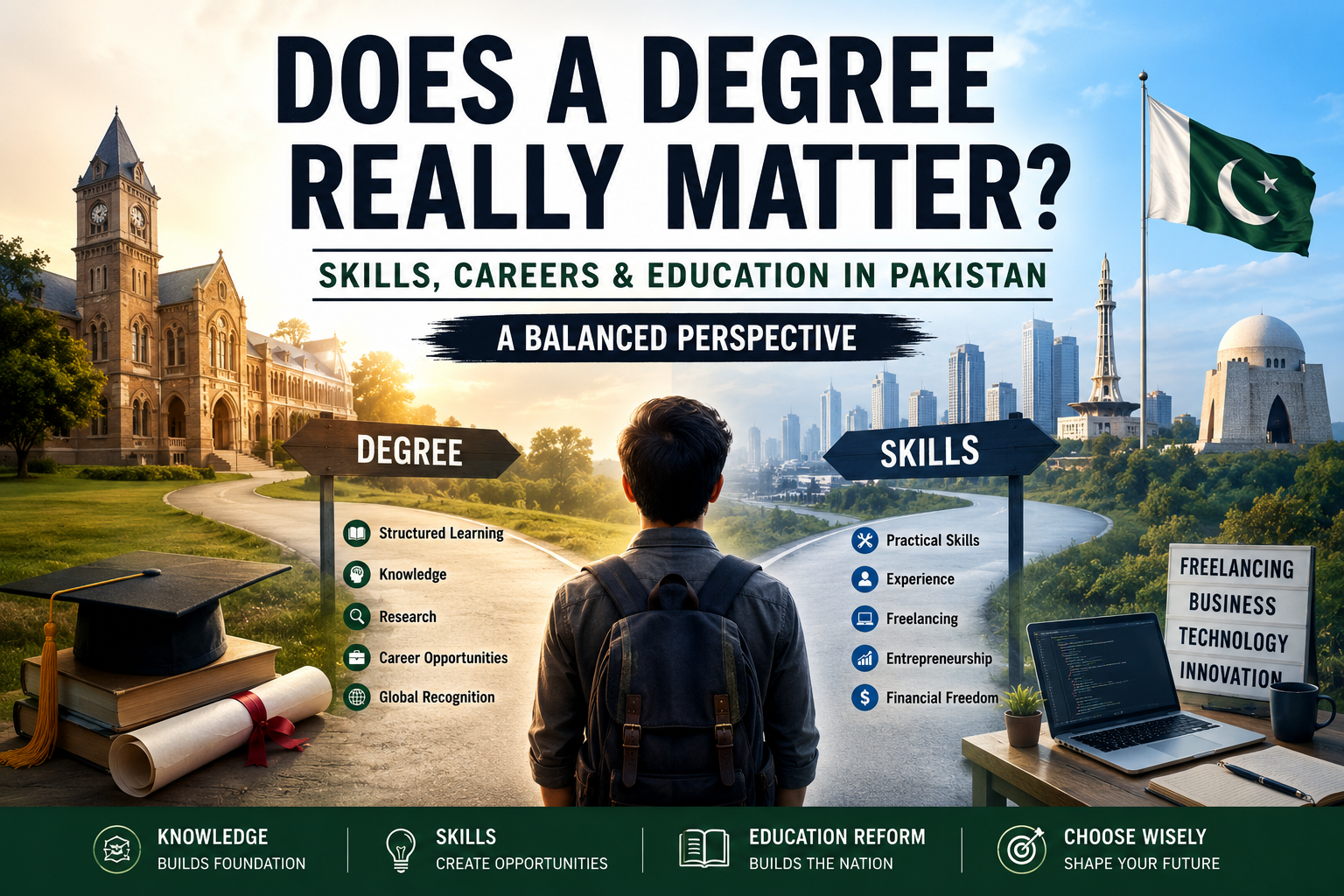
Does a Degree Really Matter in the Coming Years? A Balanced Look at Skills, Careers, and Education in Pakistan
Every few days, we see a new video on YouTube claiming that “degrees are a waste of time” and that people should invest the same money in a business, freelancing, or learning technical skills instead.
This message has become especially popular among influencers and entrepreneurs. While there is some truth in it, the reality is far more balanced. A degree is not automatically valuable, but it is also not useless.
The real question is not “Do degrees matter?” but “When does a degree matter, and when doesn’t it?”
In this article, I’ll share my perspective on both sides of the debate.
When a Degree Becomes Useless
A degree can lose its value under certain circumstances. Here are some of the most common reasons.
1. Studying Only to Get a Certificate
Many students focus only on passing exams and obtaining a degree instead of actually learning.
If your goal is simply to graduate without understanding your subject, the degree becomes nothing more than a piece of paper.
Knowledge creates opportunities—not certificates alone.
2. No Practical Skills
Today’s employers and clients want people who can solve real problems.
A computer science graduate who cannot write software or an engineering graduate who cannot solve engineering problems will struggle regardless of their degree.
Skills and practical experience matter.
3. Choosing a Field with Limited Future Demand
Some fields have shrinking job markets due to automation, artificial intelligence, and changing industries.
Choosing a degree without researching future demand can make finding employment difficult.
Students should always analyze:
- Future industry trends
- Job market demand
- Technology changes
- Global opportunities
before selecting a degree.
4. Ignoring Technology
Technology changes almost every profession.
Someone who never updates their knowledge after graduation may find that their education becomes outdated within a few years.
Learning should continue throughout life.
5. Expecting a Degree to Guarantee Success
A degree is not a guarantee of wealth.
Many graduates believe that after completing university, a high-paying job will automatically come.
Unfortunately, the world doesn’t work that way anymore.
Success usually requires:
- Skills
- Communication
- Experience
- Continuous learning
- Problem-solving ability
Why a Degree Still Matters
Despite all the criticism, degrees continue to play an essential role in society.
Here is why.
1. Many Professions Cannot Exist Without Formal Education
Imagine a world where doctors, engineers, architects, pharmacists, scientists, or pilots had no formal education.
It would be impossible.
Some professions require years of structured learning because people’s lives depend on their knowledge.
2. Research and Innovation Require Strong Educational Foundations
Almost every major invention started with education and research.
Artificial Intelligence, smartphones, medical treatments, satellites, renewable energy, and modern transportation all exist because researchers spent years studying science, engineering, mathematics, and technology.
Businesses often grow because of innovation.
Innovation grows because of research.
Research grows because of education.
Without strong educational systems, future inventions become much more difficult.
3. A Degree Builds Fundamental Knowledge
University teaches more than facts.
It helps students develop:
- Analytical thinking
- Research methods
- Critical thinking
- Problem-solving
- Teamwork
- Professional ethics
These abilities remain valuable throughout a career.
4. Many Careers Still Require Degrees
Although freelancing and entrepreneurship have grown significantly, many careers still require recognized qualifications.
Examples include:
- Medicine
- Engineering
- Law
- Teaching
- Scientific research
- Government services
- Academia
Without the required education, entering these professions is impossible.
5. Higher Education Opens Global Opportunities
Many scholarships, research programs, postgraduate admissions, and international careers require accredited degrees.
A good degree can become a gateway to opportunities around the world.
Skills vs Degree: Which One Is Better?
This question is often asked, but it may not be the right one.
The better question is:
Why not have both?
Someone with:
- A strong degree
- Practical skills
- Good communication
- Real-world experience
- Continuous learning
will usually outperform someone who has only one of these qualities.
Degrees and skills should complement each other, not compete.
The Reality of Education in Pakistan
Pakistan’s education system undoubtedly needs significant improvement.
Some of the major challenges include:
- Outdated curricula
- Heavy focus on memorization
- Limited practical learning
- Weak industry connections
- Insufficient research funding
- Lack of innovation-focused education
- Limited career counseling for students
These problems discourage many students and lead people to believe that education itself has no value.
However, the problem is not education—the problem is how education is delivered.
Instead of rejecting education, we should work to improve:
- Teaching methods
- Research culture
- University-industry collaboration
- Practical training
- Career guidance
- Modern curricula
An improved education system can produce researchers, innovators, entrepreneurs, and skilled professionals who contribute to national development.
My Perspective
In my opinion, a degree becomes useless when a student studies only to obtain a certificate without gaining real knowledge or chooses a field that has little future demand.
But education itself is never useless.
Without proper schooling, structured learning, and research, many of the technologies we use every day would never have existed. Businesses also depend on innovation, and innovation comes from research and education.
I believe students should not blindly chase degrees, nor should they blindly reject them because someone on social media says they are unnecessary.
Instead, students should:
- Choose degrees with future demand.
- Learn practical skills alongside university studies.
- Stay updated with new technologies.
- Build real projects and experience.
- Focus on solving real-world problems.
- Continue learning even after graduation.
A degree should be seen as a foundation—not the final destination.
Final Thoughts
The debate should never be “Degree or Skills.”
The real formula for success is:
Degree + Skills + Experience + Continuous Learning + Innovation
A degree alone may not guarantee success, and skills alone may not open every door.
The future belongs to those who combine education with practical ability and never stop learning.
So, before deciding whether a degree is worth it, ask yourself one question:
Am I studying just to get a certificate, or am I studying to become someone who can create value for the world?
Last updated: August 2026
Explore Free Student Tools on Taleem Guide
Calculate aggregate, check closing merits, or find top-ranked universities in Pakistan.
Merit Calculator
Calculate your aggregate percentage for NUST, FAST, COMSATS, UET.
Find Universities
Explore 200+ HEC recognized universities by city & sector.
Scholarships 2026
Browse active fully funded and need-based scholarships.
Entry Test Prep
Guides for MDCAT, ECAT, NATS, USAT & University Tests.
Get Instant Admission & Scholarship Alerts!
Join thousands of Pakistani students receiving regular updates on deadlines & test dates.

How the Merit List in Pakistani Universities Actually Works
02 Sep 2026
Entry Tests in Pakistan 2026: NAT, ECAT & NET
26 Aug 2026
Punjab Board 9th Class Result 2026 – Date, Time & How to Check
19 Aug 2026
Google in Pakistan 2026 – Office, Jobs, Benefits & Future Plans
19 Aug 2026
Top Scholarships Without IELTS for Pakistani Students 2026
15 Aug 2026Recommended For You
Stay updated with the latest education insights, admission news, and scholarship guides.
How the Merit List in Pakistani Universities Actually Works You scored 85% in your FSc and assumed you’d...
Entry tests in Pakistan can be confusing, especially when different universities and degree programs require d...
Punjab Board 9th Class Result 2026 The Punjab Board 9th Class Result 2026 is one of the most awaited results f...
Comments (0)
Leave a Public Comment
No comments published yet. Be the first to share your thoughts above!